
International Women’s Day: The “DIFFICULT” Edition
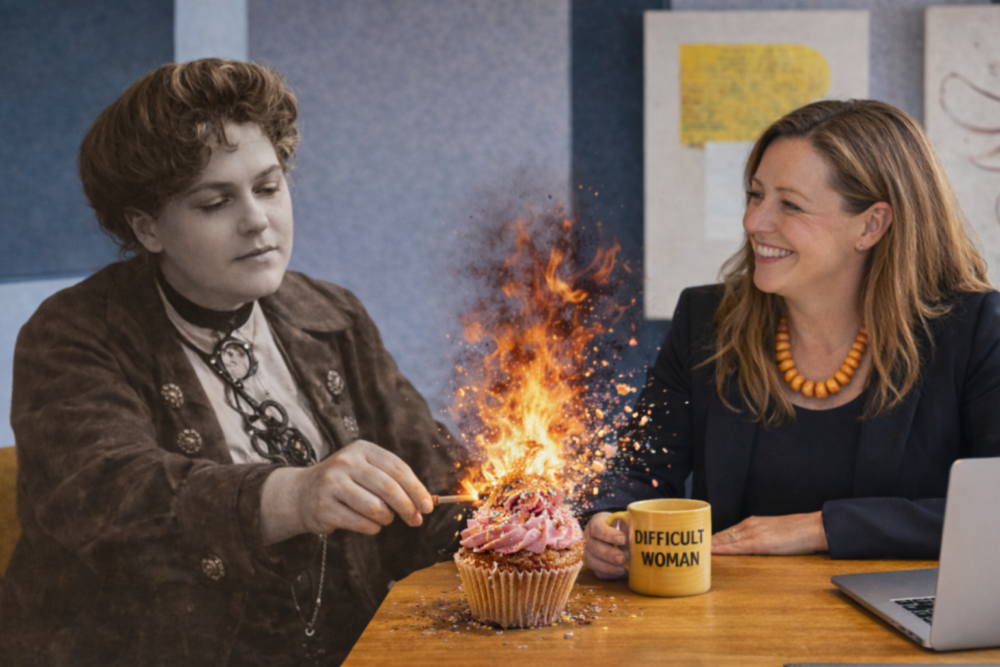
An ode of appreciation of the Difficult Women (and the people who raise them, support them, employ them, buy from them, work alongside them and appreciate them — which is to say, all of you).
This year was the first since 2017 that I didn’t host our International Women’s Day lunch at WorkLife- my network of regional coworking spaces.
I love a lunch. I love our communities. And IWD has traditionally been one of my favourite events of the year. But this year, with the advent of war, and our PM caught off-guard describing former Australian of the Year Grace Tame as…..DIFFICULT.. this year our light, bright, inclusive sunny yellow model felt a bit tone deaf for what is happening in the world.
So rather than keep on wrestling with how we would match our model to the mojo of the moment, I decided that we would let March 9 pass by, pause, regroup and recalibrate. Not because the feminist project is complete or the day matters less — but because something about the way we have been celebrating it has started to feel… off.
International Women’s Day was never meant to be Mother’s Day Lite.
It was born from working women marching in the streets demanding safety, shorter hours, fair pay and political representation.
In my own family that history has a very literal reminder. My great-great aunt Marion Milner Holmes was imprisoned in the UK for her work as a suffragette fighting for women’s right to vote and stand for election. When she was released from Holloway Prison, she was presented with a silver Holloway brooch by the Women’s Freedom League — a badge awarded to women who had been jailed for the cause. The brooch depicts the gates of the prison. No inspirational slogan. No purple cupcakes. The heavy gates of the prison as a reminder and a badge of honour.

Last year, I honoured that legacy and stood for election with the support of the Community Independents Project and Climate200 in the Federal seat of Gilmore and the State seat of Kiama. Let’s just say it was a big year and my feelings about the opportunities and challenges for women in politics, the economy, online and in the home are still settling along with my cortisol levels.

Grace Tame rejects apology from Anthony Albanese
So when our Prime Minister reflexively described former Australian of the Year Grace Tame in one word as “difficult,” my gut reaction was pretty swift. As women, we instinctively know what kind of patronising irritation can be buried under an innocuous little word like difficult.
The backlash was widespread, and I suspect the moment will linger as one of those small but defining slips of language that say way more than intended. But the reaction I think, was also a reflection of a shifting mood when it comes to contemporary feminism in Australia.
It felt a little like the cupcakes got put away and the gloves came off when Tame’s response cut straight to the point:
“‘Difficult’ is the misogynist’s code for a woman who won’t comply. History tends to call her courageous.”
Now most women in business don’t have a national platform as large as Grace’s — or the courage to wield it the way she does. But they know exactly how that word works.
“Difficult” is the quiet threat hanging in the air whenever a woman declines an unwanted advance, pushes back on an unreasonable request, asserts her rights, raises her voice — or her prices — enforces a boundary, or simply takes up more space than expected.
It’s the label that appears when a woman refuses to make powerful people comfortable.
Which is why that moment landed with such a clang across Australia — made worse, perhaps, by an apology that felt less like reflection and more like damage control.
Most women recognised the subtext immediately, and they didn’t like hearing it from a Prime Minister who has otherwise worked hard to project allyship — especially in contrast to the regular slop of overt sexism we often see across the aisle in politics.
The reverberations were still echoing through this year’s International Women’s Day conversations, clarifying something many of us had been sensing but struggling to articulate: the gap between where we thought we were on women’s equality, and where we actually are.
Back to WorkLife’s Missing 2026 IWD Lunch….

Over the years we’ve always proudly eschewed the “keynote speaker” model in favour of something much simpler for our events— a more democratic ritual of appreciation and celebration of the ordinary daily grind of juggling work, care, community and ambition that we see in so many of our female members.
I have always wanted WorkLife’s IWD event to be the antidote to the corporatisation of International Women’s Day. I never wanted anyone leaving our events after listening to someone inspirational feeling insufficient, or like they were not-enough on the very day meant to recognise their contribution.
In the past I’ve rabbited on about how a UK PR firm bought the URL to International Women’s Day 20 years ago and, through mastery of SEO, has managed to reshape the narrative each year — taking the official UN theme and watering it down into something a little more pre-masticated and corporate-friendly.
This year the gap felt particularly stark.
The UN Women theme was “Balance the Scales.” Meanwhile the pink-washed corporate theme doing the rounds was “Give to Get” — and once again many organisations unknowingly adopted the IWD-lite version and something in me flipped from mild irritation to something more akin to a rekindled feminist rage.
Because, when you place the two themes side by side, over the years, something very interesting appears…..

Once you see the slippery pattern, you can’t really unsee it. And it helped me to distill my feelings about why I was feeling so meh about celebrating in the customary way this year.
You see, the UN themes consistently focus on systems: rights, investment, leadership, safety, economic participation and structural inequality.
But the pale purple and pink corporate themes slide their focus away from the systemic problems and back into the realm of individual attitudes and behaviours: inspire, embrace, challenge, accelerate.
Both of course sound positive. But they are doing very different things. UN Women is asking institutions to examine how the gendered allocation of power and resources affects women and girls.
Whilst our shiny corporations would prefer to gently nudge individuals to think differently or try harder. Whatever sounds supportive, but will only shift the needle a degree. Perfect if your goal is to leave the systems intact and the status quo unaffected
Ah PR. You’ve done it again.
Because taken seriously in corporate Australia, IWD is a chance to reflect critically on gender equality and raise questions about….who holds decision-making power • how unpaid care work is distributed • pay structures, superannuation and labour rights • leadership pipelines • safety and harassment
None of those are branding exercises. They are structural questions. And that is where things start to get uncomfortable. And you can be a feminist at work, until you make people uncomfortable. When you cross that line you have landed in the realm of the Difficult Woman. And no one likes a difficult woman at work.
So what has happened? What seems to have changed?
Beyond the overt misogyny that still bubbles away online, I have been trying to put a finger on the quieter pushback that seems to be creeping into everyday conversations about womens issues.
The language is hesitant, softer and more slippery now. It shows up in phrases like “hasn’t it gone too far?” Or debates about quotas being a dated tool when we should be able to trust in “merit-based appointments.”
And this sideways step has caught me off guard. After a year of politics following on from the seismic cultural shift of the #MeToo movement, it felt for a while like the ground had genuinely moved. But lately it has started to feel unstable again in a way i’ve only just been able to put my finger on.
It is as if some allies have reached the limits of their goodwill and would prefer the pace of change to slow — or quietly drift back toward the comfort of the status quo. Increasingly I’m hearing a new narrative emerge from the mouths of old allies: that the pressures men are experiencing — mental health struggles, insecure employment, fathers caught up in the family court system, housing stress or economic anxiety — might just somehow be the result of a feminism that has gone too far.
Which is curious, because it’s clear to me that many of those pressures come from the very same patriarchal political, cultural and economic and systems feminism has long been critiquing.
It turns out that this backsliding is not exactly new. Research (I discovered in a wonderful Year 12 PIP I read this week by an amazing budding feminist) into the backlash following #MeToo suggests something similar is happening. When entrenched power structures begin to move, people who benefited from the old system often experience what researchers call status threat — a feeling that something important is being taken away. The result is a familiar chorus: equality is fine, but not like this… not this fast… not if it makes anyone uncomfortable.
One of the most interesting findings is that men who support gender equality can still react defensively. The research shows this happens because good people want to maintain their identity as “good and fair individuals.” So when feminist critique highlights systemic problems, it can feel like personal accusation, even when it this issue is systemic.
Last year I experienced plenty of this tension myself – as I tried to be palatable as a female candidate in a regional seat. Despite it meaning pushing through every internalised instruction women grow up with — don’t take up too much space, don’t rock the boat, don’t be too loud, definitely don’t be angry. To be acceptable required being LIKEABLE and unthreatening- the strange balancing act women in leadership are still expected to perform: be strong but not angry, ambitious but not competitive, feminine but not a feminist, agreeable always and never ever “difficult”.
Which brings me back to International Women’s Day.
So this year, instead of hosting our usual celebration, I paused, I read. I thought and instead I sang in an amazing womens social change choir led by the irrepressible Tina Broad – the Sing Express.

And back at WorkLife I confessed my wobbly indecision about how the vibe is shifting and my changing feelings about the sanitised and happy version of IWD and I invited the WorkLife community to join a “Difficult Women’s Lunch.” instead.
Once again. No panels. No keynote speakers. Just a conversation about what might actually be needed now for the women in our community.
And the response has been fascinating. Not because everyone agrees- they never do. But because many people said the same thing:
“I’ve been feeling something was off about IWD events lately too… but I couldn’t quite put it into words.”
So I don’t know exactly what comes next. But it feels like International Women’s Day may be entering a moment where it needs to reconnect with the harder questions the day was originally created to confront.
And if history tells us anything, those conversations will probably be led by…
a few difficult women.
I’m curious whether others felt this shift this year too?
PS. I write these things to organise my thoughts- and then my friend ChatGPT helps me to edit slightly. But it turns out he doesn’t like difficult women very much either- check out the suggestion for how I should adjust my tone of voice for the good folk of LinkedIn 😉


